 Nine-year-old boy brutally murders his infant sister. Mother driven mad by the crime.
The Broadside
Undated, and offering a verse account alone, this Thomas Birt sheet is headed Full particulars of the cruel and horrid murder At Westmill, near Buntingford, Hertford, by Wm. Games, a boy eight years old, On the body of his little Sister. There's no illustration, but some care's been taken in varying the size of type in this headline and spacing it out over seven centred lines to make it look as attractive as possible.
Buntingford lies midway between Letchworth and Bishop's Stortford in the English county of Hertfordshire. Westmill's about a mile-and-a-half south. The ballad sheet gives the family's name as "Games", but The Times report prefers "Game". I've gone with The Times' version here partly because I'm hoping it's more reliable and partly because it makes a better rhyme.
The Ballad
You tender parents all around,
Come listen unto me,
While I unfold a murder cold,
An awful tragedy,
Near Buntingford in Hertfordshire,
In a village called Westmill,
Thus sad inhuman murder,
Will cause your blood to chill.
This murdered child so innocent,
And just five years of age,
Has closed her little eyes in death.
All by a brother's rage,
A lad of only nine years old,
How dreadful to relate,
Each parent's heart must bleed with woe,
To think upon her fate.
The killer's name is William Game,
He struck the girl with dread,
Then with his father's bill-hook,
He wounded her dear head,
Then cut and maimed her hands and face,
In such a dreadful way,
Enough to make your blood run cold,
When thinking of that day.
How little did their parents think,
When they were far from home,
That such a shocking fate as this,
Would to their daughter come,
That they should see her mangled corpse,
Lay bleeding on the floor,
The darling child they loved so well,
Alas was now no more.
Her tender mother when she found,
Her darling child was dead,
Was driven into wild despair,
Her senses now are fled,
You tender parents when you hear,
This shocking tale of woe,
The feeling for your children dear,
Will cause your tears to flow.
This youthful killer now does find,
How hard 'tis to bewail,
The horrid crime of murder,
Within a dismal jail,
May God some comfort now impart,
To parents of this Cain,
Who for their murdered daughter mourn,
How dreadful is their pain.
The Facts
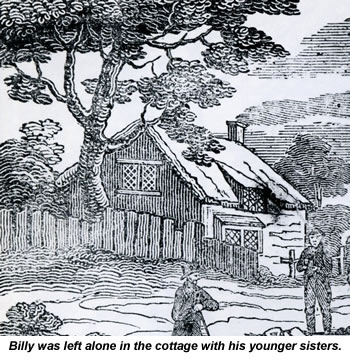
A report in The Times of September 1, 1848, confirms this ballad sprang from a real case. On August 24 that year, William Game, his wife and eldest daughter left their tied cottage at Coles Park, Westmill, for a day working in the fields. Billy, their nine-year-old son, was left in charge of his three younger sisters: Lucy, who was four, Hannah, aged two, and an unnamed baby.
Between 6:00 and 7:00pm, Mrs Game returned with the oldest daughter to find Billy, Hannah and the baby waiting by the garden gate. Asked where Lucy was, Billy replied "She lies dead in the house". Mrs Game raised the alarm, a policeman called Inspector Bryant arrived, and he went in to examine Lucy's remains.
"On examining the body of the child, he found the right arm frightfully shattered and the skull fractured, the brains protruding," The Times report says. "Blood and brains were on the outside door of the house, and on the window in the room some brains, and also near the door a pool of blood."
Moving through to the bedroom, Bryant found an old gun, which he saw had been recently discharged. William Game confirmed the gun had been loaded when he'd last seen it, and the surgeon who later examined Lucy's body said her wounds "might be caused by a gunshot or some heavy blunt instrument used with great force". Searching the house a few hours later, police found a blood-stained bill-hook which William said he'd used to chop up a rabbit on the previous Sunday.
An inquest was held on Friday - the day after Lucy's death - and Billy testified that he'd left her alive and well in the house at about 5:15 the previous evening while he walked up the hill towards Westmill. He said he'd got back to the house about half an hour later and found the door open, with Lucy lying dead inside. He said he then shut the door and went to wait at the gate until his mother got home. Billy had spoken to several passing neighbours while standing at the gate, but told none of them about Lucy.
The next day, Bryant compared Billy's story to the coroner's evidence and that of a boy called Johnny Wallis, who had passed the gate with his mother while Billy stood there. He decided to question Billy some more, and this time the boy told him he'd seen a suspicious-looking man walking up Thrift Lane towards the Rectory at about 5:00pm on Thursday and, five minutes later, heard a gunshot at the back of the Games' house. That was when he walked in and found Lucy dead, he said.
Bryant clearly didn't believe a word of this, and returned to Billy with the news that no-one could trace anyone matching the strange man's description. At this point, Billy seems to have broken down, and decided he had no choice but to tell the truth. "I wanted my sister to stay in the house on Thursday while I went to see if my mother was coming," he said. "She said she should not. Then I went into the little plantation by the woodhouse and fetched a stick. I went back to the house, and asked Lucy if she would stop in the house. She said she should go along with Billy.
"Then I hit her ever so many times on the head with the stick. She rolled down. I then fetched the bill from the corner by the pump and hit her on the arm ever so many times. I took hold of her body and moved her further into the house, and laid her on the bricks where she was found.
"I washed the bill in some water that was in a pail outside against the pump and wiped it on a rag, which I hurled away into the plantation against the apple tree. I put the bill where I took it from, and threw the water on the potato ground and put the pail near the pump. I threw the stick ever so far away down the hedge in Surcoat-mead. It went into the hedge. One end is bloody."
That was only the half of it, as Bryant discovered when he attended a medical examination of Lucy's body on August 29. There he saw several bits of shot removed from her brain, which matched two similar pieces found in the room where Lucy died. Confronted with this, Billy confessed that he'd taken his father's old gun from the bedroom and held it to Lucy's head. "It clicked several times, and then went off," he told Bryant. "And she took and rolled down." It was only then, he added, that he'd started hitting Lucy with the stick and the bill-hook, before disposing of the evidence with the chilling calm he'd already described.
Bryant was never able to find the stick, but he did find the bloody rag near the apple tree his young suspect had mentioned. Billy signed a confession admitting all he'd done - or at least put his mark to it - and was sent to Hertford Jail to await the next assizes.
Note
With Billy's confession on record, it seems almost certain he would have been convicted. Children that age were very seldom executed, however, and there's no record of an exception being made in this case. Transportation of convicts to Australia continued till 1857, so perhaps he was able to begin a new life there.
Update
I posted this account of the ballad online in October 2010, and that's where matters rested for the next three years. Then, in November 2013, I received a letter from Dick Mathews enclosing some scans of old Hertford Mercury stories which show I was quite mistaken about Billy's fate.
The first of these, dated September 2, 1848, reports Lucy's inquest hearing at Westmill's Sword in Hand pub on the day after she was killed. The coroner's jury there heard all the evidence described above and, after 90 minutes' deliberation, decided Billy should be sent on to Hertford Assizes on a charge of Wilful Murder. His case was duly included on those to be heard at the assizes Lent sessions the following year, which began on February 27.
The judge presiding at these assizes, Mr Justice Wightman, began proceedings by briefing his Grand Jury of 23 men on all the cases brought forward for those sessions. At that time, every assizes session began with a Grand Jury like this one deciding which of the docketed cases should go forward for trial and which should not. The 12-strong jury for each individual day's hearings would then be drawn from this larger panel.
"At the start of the assizes, [the Grand Jury] would vet the indictments and statements, and hear the evidence from the prosecutors and their witnesses, but not defendants," the Victorian Crime & Punishment website explains. "If a Grand Jury believed the evidence was sufficient to warrant a trial, the case was approved as a 'true bill'; those rejected were labelled 'ignoramus' and the case was dropped."
The Hertford Mercury's March 3, 1849 issue reports Justice Wightman's remarks briefing this Grand Jury before they considered Billy's case. "If in this case, the evidence shall show to you that the child manifested an ability to know good from evil, he may then be held responsible as an adult," he told them. "If [that is the case], then the crime which he has committed can be no less than murder; for it is difficult to suppose a case of culpable negligence which could reduce it to manslaughter."
By ruling out the half-way house verdict of manslaughter in this way, Wightman made it clear that sending Billy to trial must result in a finding of either Accidental Death or Wilful Murder - neither of which seemed to fit the facts in this particular case. The Grand Jury was understandably reluctant to see such a young boy convicted of murder, and yet how could Lucy's death be deemed an accident when Billy had deliberately put a gun against her head and pulled the trigger? Faced with this very stark choice, the jurors responded with the "ignoramus" ruling described above. In the jargon of the day they "ignored the bill", which effectively scuppered any chance of prosecuting Billy on the charges as they stood.
The earlier coroner's verdict meant matters had to be resolved somehow, so a hearing was still scheduled for Billy, but this began with the prosecutor, Mr Rodwell, declaring he intended to present no evidence. "I have come to the conclusion that it would only be wasting the time of the court if I should proceed with the prosecution," Rodwell announced. "My opinion is that the jury would form the same opinion as the Grand Jury have formed and acquit the prisoner. I think they would not find the boy guilty of murder, and I am of the opinion that the case is not reducible to one of manslaughter."
Justice Wightman agreed. "It is one of those peculiar and unfortunate cases which must either be pronounced one of murder or accident," he said. "I think it is best for the ends of justice that he should be acquitted. But it is necessary that he should be arraigned." This is the process of formally reading the charges against a defendant while he is in court to hear them, and to hear his plea of Guilty or Not Guilty in return.
"The prisoner, an innocent and intelligent-looking lad, being brought to the bar to be arraigned, looked wildly around the court, gazing upon the spectators with an air of wonder, apparently unconscious of the awful position in which he stood," the Hertford Mercury reports. "He made no answer [to the charges] until told to plead Not Guilty, which he did immediately, evidently not understanding the nature of the proceedings or of the offence he was charged with."
Rodwell repeated that he would be offering no evidence in this case, leaving only Wightman's summing up before the trial jury could produce the Not Guilty verdict which was now its only option. Wightman slipped in a few sharp remarks about William Games' carelessness in leaving a loaded gun where his young son could so easily get at it, but repeated that a manslaughter verdict simply wasn't possible in this case. The formal Not Guilty verdict was duly recorded, and Billy's parents took him home.
To hear Ernest Johnson singing Murder At Westmill (in a version he calls The Westmill Murder), please visit his Soundcloud page here.
To watch Partick Rose singing Murder at Westmill, please visit the YouTube page here. Patrick recorded the song as his entry for Islington Folk Club's Trad2Mad 2013 competition. There's an audio-only recording of Patrick's performance on this Soundcloud page.
Sources
* Full Particulars of the Cruel and Horrid Murder etc (Thomas Birt, 1848).
* The Times, September 1, 1848.
* Hertford Mercury, September 2, 1848.
* Hertford Mercury, March 3, 1849.